Posts

Showing posts with the label LAIR

LAIR - A* Path Planning
Image
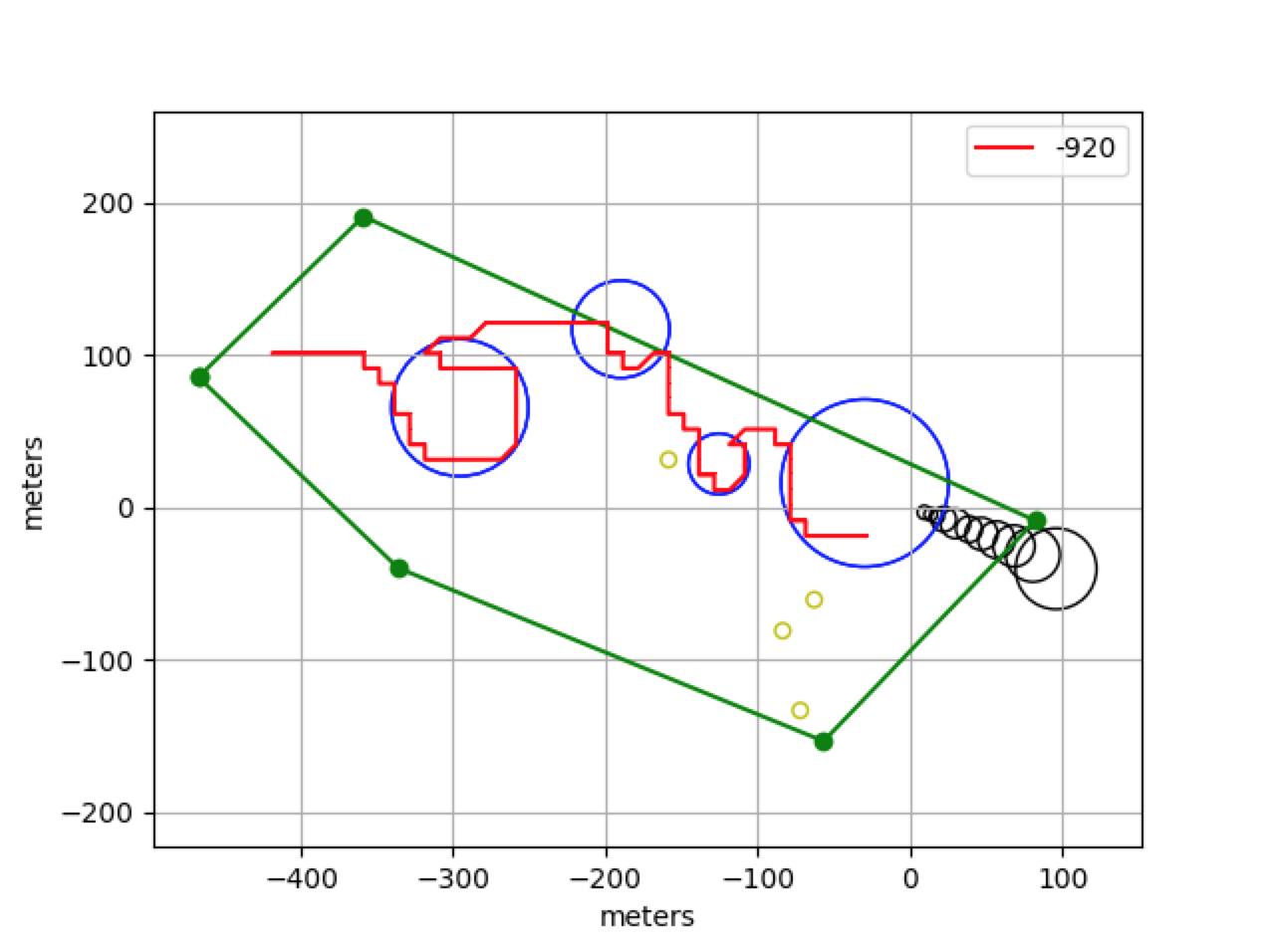
Hi everyone! My name is Alicia Lu, a rising sophomore working in the LAIR (Lab for Autonomous and Intelligent Robotics). This summer I have been working with my fellow classmates and Prof. Clark on developing a multi-AUV system to track sharks while simultaneously collecting marine habitat data.  My job on the path-planning team is to modify the classic A* search algorithm (often seen as an extension of the famous Dijkstra Algorithm) to include our expected functionalities: track sharks of fixed positions and cover as many new habitats as possible. I have developed two versions of path planning algorithms that can complete the listed tasks.  This post shows the simulation results from the algorithm that aims to explore as many new habitats as possible while trying to maximize time spent in each habitat. The longer time spent in a habitat implies longer trajectory length within a habitat. Figure 1 below illustrates a trajectory that starts at (-215.63, -5.89) and has a length o...
LAIR - Path Planning

Image
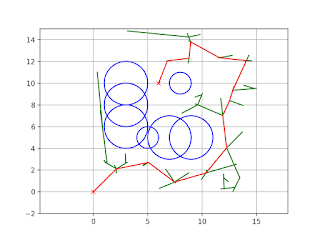
Hi Everyone, I am Linda Li, a rising sophomore from Harvey Mudd College. Over the past weeks, I have worked in Lab for Autonomous and Intelligent Robotics (LAIR) under the supervision of Prof Clark. I am excited to share some of my progress with you all. I am working on Shark Tracking with AUVs (Autonomous Underwater Vehicle) project, where we want to develop a multi-AUV system to track tagged sharks for a long period of time.  At the beginning of this summer, I explored and implemented path planning algorithms such that AUVs will be able to plan the optimal path from current positions to the target sharks while avoiding obstacles along the way. I focused on the Rapidly-exploring Random Tree (RRT) algorithm. This algorithm finds the path from the starting point to the goal by iterating the process of randomly choosing a point in the whole space, connecting this point with the closest point in the tree, and testing if the new subpath is collision-free with any obstacles until it hit...

LAIR- All About Particle Filters

Image
Hi everyone!   My name is Hannah, and I am researching under LAIR this summer with Prof. Clark!   My partner, Olivia, and I have kicked off the summer with working on a Particle Filter. The basic idea of a particle filter is that it can be used as a localization technique. In our case, we are working on coding up a Particle Filter that will run on our Autonomous Underwater Vehicle (AUV) so that it can estimate the location of a shark the AUV is tracking.       A Particle Filter works by creating a collection of random particles, and each particle is its own estimate of the shark’s position. These random particles have a ‘weight’ or importance factor. The weights associated with each particle are updated according to how close the particle is from the AUV’s most recent measurement of the shark’s position. The equation used for this update is a Gaussian function. An easy way to think of the weight is that a higher weight assumes that the particle has more importan...

Microglider Simulation Update!

Image
        Hello! I’m Hugo, a student researcher in the LAIR. I work on the Microglider team, where we are trying to develop autonomous underwater glider robots. This robot will float and sink to reach operator-selected depths, controlled by electrolysis and vibration-assisted bubble leak. This will cause the robot to move laterally as lift forces act on the wings on the side of the glider. Among the work we have completed is a prototype of the robot that can float and sink under human control, a PD control system to set robot depth, and characterization of the robot’s electrolysis and leak rates. We want to model the robot using a simulation that includes the robot’s vertical and lateral position, as well as its pitch (tilting forward and backward). This simulation can then be translated into a control system that integrates robot dynamics, leak rate, and electrolysis rate to convert user inputs into desired robot position outputs. So far, I have already coded th...